You're Here. Now Actually Be Here: The Forgotten Ritual of Arriving on Purpose
Photo: Georgia National Guard, CC BY 2.0, via Wikimedia Commons
You drove four hours. You found the trailhead. You set your bag down on the cabin porch and looked out at the pines stretching toward the ridge. And then, almost immediately, your brain started composing a reply to that work email you forgot to send.
Sound familiar?
There's a name for what happens in those first murky hours after you land somewhere new — that low-grade static where your mind keeps buffering between where you were and where you are. Researchers sometimes call it cognitive residue, the mental trail left behind by unfinished tasks and lingering obligations. But you don't need a lab coat to recognize it. You've felt it every time you "got away" and somehow brought everything with you anyway.
The good news: arrival is a skill. And like most skills worth having, it can be practiced.
The Transition Blind Spot
Modern American life is obsessed with destinations. We plan the trip, count down the days, pack the bags — and then sprint from one state of being to the next without pausing to acknowledge the crossing. We treat transitions like loading screens: inconvenient gaps to be minimized between the content that actually matters.
But in Japanese aesthetics, transitions are the content. The concept of shibui — often translated as a quiet, understated beauty — shows up not just in objects but in movement through space. Traditional Japanese design has long understood that how you enter a place shapes how you inhabit it. The garden path that winds before the tea house isn't inefficient. It's essential. It gives your nervous system time to change clothes.
The roji, or dewy path, in Japanese garden design literally exists to slow you down before you arrive at something sacred. Each stone, each turn, each moment of pausing to notice moss is a signal: you are no longer in the ordinary world. By the time you reach the door, you've already begun the transition. Your mind has been given permission to release.
We've built almost none of that into American life.
Why Your Brain Keeps Traveling After Your Body Stops
The problem isn't willpower or mindfulness failures. It's neurological. Your brain's default mode network — the system that runs when you're not focused on a specific task — is essentially a rumination machine. Left to its own devices, it replays the past and rehearses the future. Getting in a car or on a plane doesn't turn it off. Neither does a beautiful view.
What does interrupt it is a deliberate sensory or behavioral cue — something that signals a genuine shift in context. Think of it like a chapter break for your nervous system. Without that break, your brain reads the new environment as a continuation of the same story.
This is why people who've spent time at places like Odaka Camp often describe feeling like they "finally exhaled" somewhere around day two. The first day, the residue is still burning off. By the second, something shifts. The question worth asking: what if you could manufacture that shift on purpose, right from the moment you arrive?
The Practice of Intentional Arrival
You don't need a Japanese tea garden or a wilderness retreat to build a meaningful arrival ritual. You need a repeatable sequence of small acts that your brain learns to associate with transition complete.
Here's what that can actually look like:
Before you leave home — close the loop. One of the biggest sources of cognitive residue is unfinished business. Before a trip, spend ten minutes writing down everything that's actively running in your head: the tasks, the worries, the half-finished thoughts. Put them somewhere physical — a notebook, a sticky note on your desk. The act of externalizing them tells your brain it doesn't have to keep holding them. You've parked them. They'll be there when you get back.
On the road — mark the crossing. Choose a specific moment in your journey that becomes your symbolic threshold. It could be the point where cell service drops. It could be the first time you smell pine trees through a cracked window. It could be a song you only play on the way to somewhere, never on the way home. Make it consistent. Over time, your nervous system will start responding to that cue before you even consciously register it.
When you arrive — use your hands before your phone. The single most powerful thing you can do in the first ten minutes is to engage your body in something physical and low-stakes. Unpack slowly. Arrange your things. Fill a glass of water and drink it standing at the window. Touch the surfaces. Feel the temperature of the air. This isn't woo — it's sensory grounding, and it works by pulling your attention out of narrative thought and into direct experience.
Name the arrival out loud. This one feels slightly ridiculous until you try it. Simply say — to yourself, to a friend, to no one in particular — "I'm here." Two words. It sounds absurdly simple, but language is one of the most powerful context-shifting tools we have. It's a declaration. It draws a line.
What Camp Knew All Along
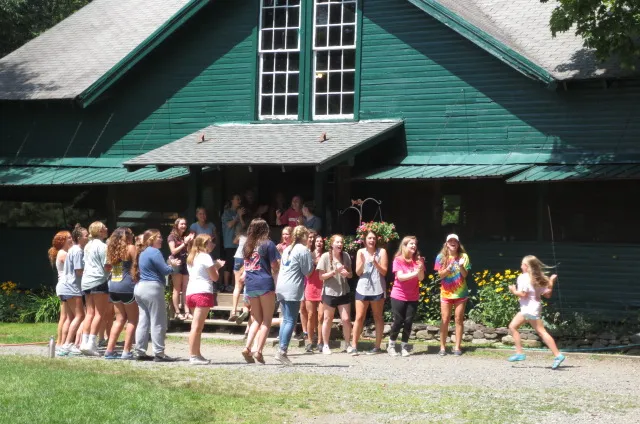
Anyone who's spent time at a summer camp — or a retreat, or a place with intentional structure — has experienced a version of this whether they knew it or not. The opening ceremony. The first campfire. The rule about leaving phones in the cabin. These aren't arbitrary traditions. They're engineered arrivals. They exist to help your brain make the crossing from ordinary life to something set apart.
Odaka Camp's whole ethos is built around this idea: that stillness isn't something you find by accident. You create the conditions for it. You mark the threshold. You signal to yourself that this time, this place, this moment is different — and then you let your nervous system catch up.
The Japanese have a phrase, ichi-go ichi-e, which translates roughly as "one time, one meeting" — the understanding that this exact moment will never come again. It's not a pressure. It's an invitation. Every arrival is a once-in-a-lifetime event dressed up as an ordinary afternoon.
The Ritual Is the Point
We tend to think of rituals as things that happen around the important stuff — the pregame warm-up, the pre-meal grace, the pre-sleep routine. But the ritual isn't the wrapper. It's the thing itself. It's what separates an experience from a location.
You can stand in the most beautiful place on earth and miss it entirely because your brain is still sitting in traffic on the 405. Or you can learn to close the door behind you — deliberately, gently, with intention — and actually walk into the room you came all this way to enter.
The destination was never the point. The arrival was.