What a Woven Bracelet Teaches You About the True Cost of Connection
Photo: 黃景淵, CC BY-SA 4.0, via Wikimedia Commons
Somewhere in a drawer right now, you probably have one. A faded, fraying loop of embroidery floss that you absolutely cannot bring yourself to throw away. Maybe it came from a bunk-mate at summer camp. Maybe a cousin made it at a family reunion. Maybe a friend slid it across a coffee shop table without saying much at all.
Whatever the origin story, the bracelet stayed. And the $200 candle you bought yourself last month? Already forgotten.
There's something worth unpacking there.
Your Brain Knows the Difference
Neuroscientists have been quietly building a case for what most of us already feel in our gut: handmade gifts activate the brain differently than purchased ones. When you receive something that someone made for you — not ordered, not wrapped in branded tissue paper, but actually constructed with their hands and attention — your brain registers it as a social signal of a very specific kind.
Research on what's called the "labor illusion" shows that people assign significantly more value to things when they can see or imagine the effort behind them. But the effect goes deeper than perceived value. The act of receiving something handmade triggers the same neural pathways associated with trust-building and long-term social bonding. Your brain, in other words, categorizes it differently than a transaction. It files it under relationship.
This is why you kept the bracelet.
The Reciprocity Loop Nobody Talks About
Gift-giving has been a cornerstone of human social architecture for as long as we've had communities. Anthropologists call it reciprocal exchange — the back-and-forth of giving and receiving that creates invisible threads of obligation, gratitude, and mutual investment between people. It's not manipulation. It's connection technology, and it's been running in the background of every meaningful human relationship since before recorded history.
Handmade exchanges supercharge this loop. When someone makes something for you, the gift carries information that a purchase simply can't: I thought about you while I did this. I spent time on you specifically. This exists because of you.
That's a very different message than a gift card.
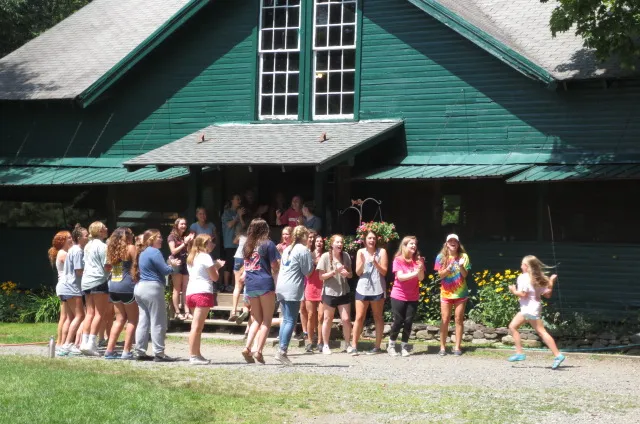
Camp alumni talk about this all the time. Ask anyone who spent real time at a summer camp about the friendships that stuck, and the handmade exchange almost always comes up. A bracelet passed across a picnic table. A friendship knot tied at the end of the last night. A small woven thing that somehow carried the weight of an entire summer.
"It wasn't about the bracelet," one Odaka Camp community member put it recently. "It was about the fact that she made it during rest hour, when she could've been doing literally anything else. She chose to spend that time making something for me. That's what I kept."
Why $200 Can't Buy What Thirty Minutes Can
This isn't an argument against spending money on people you love. It's an argument for understanding what different kinds of giving actually communicate.
A purchased gift says: I value you enough to allocate resources toward you. That matters. But a handmade gift says something more specific: I value you enough to give you something that can't be replicated or returned. I made this once, for you, and it will never exist again.
Scarcity plus intention equals meaning. It's a formula that no retail environment can replicate, no matter how elegant the packaging.
The interesting thing is that the maker benefits just as much as the recipient. Studies on what psychologists call "prosocial spending" — using your resources (including time and effort) to benefit others — consistently show that givers experience greater boosts in wellbeing than receivers. Making something for someone else is, it turns out, one of the most reliable mood-elevating activities available to human beings. No subscription required.
Building Your Own Gift Circle
So how do you bring this into everyday life, outside of a camp setting? It's simpler than you might think, and it doesn't require any particular craft skill.
Start with intention, not materials. A gift circle doesn't have to involve bracelets. It can be a handwritten note, a playlist made specifically for one person, a small drawing, a recipe card written out by hand. The medium matters less than the deliberateness behind it.
Create a ritual around the exchange. One of the reasons camp handmade exchanges feel so significant is that they happen within a container — a specific time, a specific place, a specific set of people. You can recreate that. Gather a small group of friends, set aside an afternoon, and make something simple for each person in the circle. The ritual amplifies the meaning.
Resist the urge to over-produce. The charm of a friendship bracelet is its simplicity. The moment you start worrying about whether your handmade gift is "good enough," you've shifted the energy from giving to performing. Imperfection is not a flaw in a handmade gift — it's the proof of humanity.
Give without occasion. One of the most powerful things about camp-style handmade exchanges is that they don't wait for birthdays or holidays. They happen because someone thought of you on a Tuesday. Imagine receiving something handmade on a random Wednesday in February. The unexpectedness doubles the impact.
The Quiet Rebellion of Making Something
There's a reason Odaka Camp's whole ethos centers on slowing down, making things with your hands, and investing in experiences over acquisitions. It's not nostalgia for nostalgia's sake. It's a recognition that the modern economy has optimized brilliantly for convenience and speed while quietly dismantling the slower, messier, more meaningful forms of exchange that actually build community.
A friendship bracelet is, in some sense, a small act of resistance. It says: I'm not going to outsource my affection. I'm going to sit with this thread and these colors and think about you for the twenty minutes it takes to make this. I'm going to give you something that Amazon cannot ship.
That's worth more than $200. It's worth more than most things, actually.
Keep the bracelet. Make one for someone else. See what happens.