Forget the Bestseller List: The Personal Growth System That's Been Running in the Woods Since 1861
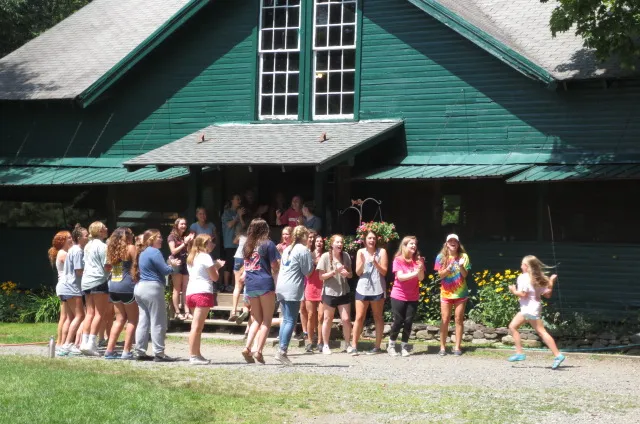
Photo: Srannamartina, CC BY-SA 4.0, via Wikimedia Commons
Every January, millions of Americans buy a book that promises to rewire their habits, unlock their potential, or fundamentally change who they are. By March, most of those books are holding up a wobbly coffee table leg. The self-help industry generates over $13 billion a year in the US, and yet study after study suggests that the vast majority of self-improvement programs produce little to no lasting behavioral change.
Meanwhile, a completely different kind of personal development has been operating quietly in the woods, on lakeshores, and around campfires since before the Civil War. No bestseller lists. No celebrity endorsements. No 30-day challenges. Just the steady, almost unremarkable process of people becoming more capable, more connected, and more themselves.
That's the camp model. And it works in ways that most modern self-help frameworks don't even come close to replicating.
The Problem With Reading About Change
Here's what most personal development content gets fundamentally wrong: it treats transformation as an intellectual exercise. Read the chapter. Absorb the framework. Apply the insight. Repeat.
But human beings don't change through comprehension alone. We change through experience — specifically, through doing things in environments that give us immediate, honest feedback. A book can tell you that vulnerability builds connection. A ropes course three feet off the ground, with your cabin group watching and rooting for you, makes you feel it in your nervous system in a way no paragraph ever could.
This is the core of what you might call the Odaka Principle: lasting growth happens when knowledge and action are collapsed into the same moment, inside a community that holds you accountable simply by being present.
Small Wins, Stacked Deliberately
One of the most quietly brilliant things about how traditional summer camps are structured is the progression model. You don't arrive at camp and immediately attempt the advanced kayaking route or lead the overnight hike. You start with something achievable — something you can actually do today — and you build from there.
This isn't coddling. It's architecture.
Psychologists call it mastery sequencing: the practice of arranging challenges in a ladder of increasing difficulty, where each rung is genuinely reachable from the one below it. Every small win releases a micro-dose of confidence. That confidence makes the next challenge feel approachable rather than terrifying. Over time, you accumulate a kind of internal evidence — proof, drawn from your own lived experience, that you are capable of more than you thought.
Compare that to the typical self-help approach, which often presents the end goal first and leaves you to reverse-engineer your way there. You want to run a marathon? Great. Here are the 12 habits of elite runners. The gap between who you are today and who the book is describing can feel so enormous that most people quietly close the cover and move on.
Camp doesn't show you the summit. It shows you the next step on the trail.
Community as Infrastructure, Not Decoration
The second thing camp gets right is something that most solo self-improvement programs treat as optional: community.
In the self-help world, other people are usually framed as accountability partners — a nice add-on if you can find them, but not structurally essential. In the camp model, the group isn't a bonus feature. It's the entire operating system.
When you live, eat, work, and play alongside the same people for days or weeks, something shifts in how you show up. You can't quietly fail and then reset without anyone noticing. You also can't quietly succeed without someone celebrating it. The group becomes a kind of mirror that reflects your growth back to you before you're even aware it's happening.
This social accountability isn't about pressure or judgment. It's about witness. Having your effort seen — really seen — by people you trust is one of the most powerful motivators in human psychology. It's why even the most introverted camper tends to attempt things at camp they'd never try alone at home.
Low Stakes, High Learning
There's another structural advantage to the camp environment that rarely gets discussed: the stakes are genuinely low.
If you mess up the knot on your lanyard, nobody gets fired. If your team loses the capture-the-flag game, the sun still sets beautifully. If you try a new way of communicating with people and it comes out awkward, tomorrow is a completely fresh start.
This low-stakes container is actually essential for learning. When the consequences of failure are severe — financially, professionally, socially — the brain shifts into threat-response mode. You stop experimenting. You default to what's familiar and safe. Innovation, vulnerability, and genuine growth all require a certain psychological safety that high-pressure environments systematically destroy.
Camp creates that safety by design. The entire environment communicates: you can try things here. You can fail here. That's the whole point.
Applying This to Your Adult Life (No Retreat Required)
You don't need to book two weeks in the woods to start operating by these principles. But you do need to be intentional about engineering the conditions that make them possible.
Start smaller than feels necessary. Whatever change you're pursuing, find the most basic, achievable version of it and do that first. Not as a warmup — as the actual work. Small wins are the foundation, not the preamble.
Find your cabin group. This means identifying a small cluster of people — three to five is plenty — who will witness your effort. Not cheerleaders. Witnesses. People who actually know what you're working on and see you showing up for it.
Create a low-stakes practice space. Identify one area of your life where you can experiment without major consequences. A creative project. A new physical skill. A volunteer role. Use it as your personal proving ground, the place where you gather evidence about what you're capable of.
Collapse the distance between learning and doing. When you encounter a new idea or framework, ask yourself: what is the smallest possible action I can take today that puts this into practice? Don't let insight live only in your head.
The Stillness Inside the System
What makes the camp model feel different from most self-improvement approaches isn't just its effectiveness — it's its quality. Growth at camp doesn't usually feel urgent or anxious. It feels natural, almost inevitable, like something that was always going to happen once the right conditions were in place.
That's the thing about building something real. It doesn't announce itself. It just quietly becomes part of who you are.
The bestseller list will always have a new title promising a faster, easier path to your best self. But the oldest, most reliable personal development system in America has been operating without a marketing budget for over 150 years — and it's still producing results that no chapter summary can match.
The woods have always known something the bookshelf doesn't.