Six Inches and a Stranger: The Life Skills Nobody Tells You That Bunk Beds Actually Teach
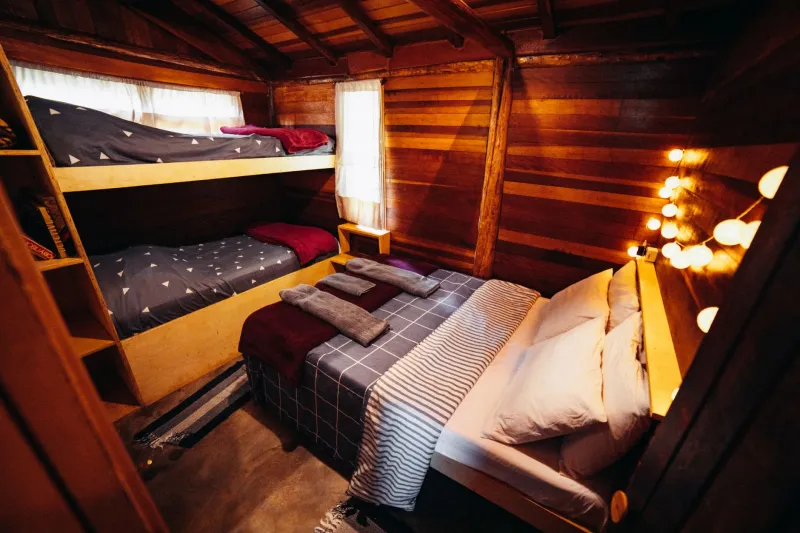
Let's be honest about the bunk bed. It is not a comfortable piece of furniture. The mattress is approximately the thickness of a pancake. The ladder is a hazard. If you're on top, you have roughly sixteen inches of clearance between your face and the ceiling. If you're on the bottom, someone else's weight presses down on the springs above you like a reminder that you are never, ever alone.
And yet. Ask almost anyone who spent significant time in one — at camp, in a college dorm, on a military base — and they'll tell you that some of their most formative moments happened in that cramped, awkward, deeply human space.
That's not a coincidence.
The Forced Intimacy Nobody Signed Up For
The thing about bunk life is that you don't choose it. You arrive, you get assigned, and suddenly you are sharing approximately 40 square feet of personal space with a person whose name you learned twenty minutes ago. Their alarm goes off at 6:45. You're a 7:30 person. Negotiations begin immediately.
This is, developmentally speaking, enormously useful.
Most of the conflict we experience as adults stems from the gap between our expectations and other people's reality. We expect others to operate on our schedule, respect our preferences, and intuitively understand our needs. The bunk environment obliterates that fantasy on day one. Your bunkmate is not going to stop rustling their snack bag at 10 PM because you're trying to sleep. They're going to rustle it. And you're going to have to figure out what to do with that.
Some kids cry. Some kids fume. Most of them, eventually, talk. And that — that moment of having to actually say hey, can you maybe do that earlier? — is the beginning of something important.
Empathy as a Survival Strategy
Here's something that camp counselors have known for decades and developmental psychologists have been slowly confirming: forced proximity, when managed well, is one of the fastest routes to empathy.
When you share a small space with someone, you learn their rhythms whether you want to or not. You notice when they're tired before they say so. You figure out that they get quiet when they're anxious, not distant. You discover that the kid who seemed annoying on day one has a reason for the way they are — a home situation, a fear, a history — and that reason changes how you see them.
This is not the kind of empathy you can teach in a classroom. It's not conceptual. It's built through observation, proximity, and the slow accumulation of shared experience in a space where there's nowhere to go and no screen to look at instead.
Research on close-quarters living consistently shows that people who have navigated shared spaces — particularly during formative years — demonstrate higher tolerance for ambiguity, stronger perspective-taking skills, and more flexible social behavior. In plain terms: they're easier to be around, and they find it easier to be around others.
Conflict Resolution Without a Referee
One of the most underrated aspects of bunk life is that adults are largely absent from it. Yes, there's a counselor. But the counselor isn't in the bunk at 11 PM when someone won't stop talking and someone else needs to sleep. The resolution — if there is one — has to come from the kids themselves.
This is where things get interesting. Without the option of appealing to authority, children and teenagers are forced to develop their own conflict resolution toolkit. They learn to negotiate. They learn to compromise without feeling like they've lost. They learn that sometimes you let something go not because it doesn't matter, but because the relationship matters more.
These are skills that adults pay therapists to help them develop. Bunk life offers them for free, embedded in the daily friction of shared existence.
Not every conflict gets resolved cleanly, of course. Some bunk assignments are genuinely miserable. But even those miserable ones teach something — about boundaries, about self-advocacy, about the difference between a problem you can solve and one you have to endure. That's a curriculum you can't find in any course catalog.
The Ritual of Shared Routine
There's another dimension to bunk life that gets overlooked: the power of shared routine. Lights out at the same time. Meals together. The particular chaos of eight people trying to use one bathroom in the same twenty-minute window. These rhythms, as annoying as they can be in the moment, create something that psychologists call "temporal bonding" — a sense of shared experience built not through dramatic events, but through the repetition of ordinary ones.
This is why bunkmates often become some of the closest friends people ever make, even if they had almost nothing in common when they arrived. They didn't bond over shared interests. They bonded over shared mornings.
Adults are increasingly seeking this out intentionally. Retreat centers, intentional communities, and co-living spaces have seen significant growth in recent years — and the appeal isn't just economic. People are chasing the particular kind of connection that only comes from being physically present with others over time, in a space where everyone is equally uncomfortable and equally invested in making it work.
What the Bunk Teaches That the Couch Can't
Therapy is valuable. Self-help is useful. But there's a category of growth that only happens through direct, unmediated contact with other people in real space — and the bunk bed is, improbably, one of the best environments for it.
You learn patience not by being told to be patient, but by waiting for someone else to finish in the bathroom. You learn generosity not by reading about it, but by lending your flashlight without being asked. You learn that people are complicated and still worth knowing, not as an abstract principle, but as a lived, daily, sometimes-exhausting truth.
At Odaka Camp, we believe that stillness and connection aren't opposites. Sometimes the most grounding thing you can do is get close enough to another person that you can hear them breathing in the dark — and decide, consciously, to stay.
The bunk bed isn't comfortable. But it might be exactly what you need.