Permission Slips: Why Flopping in Public Is the Fastest Way to Belong
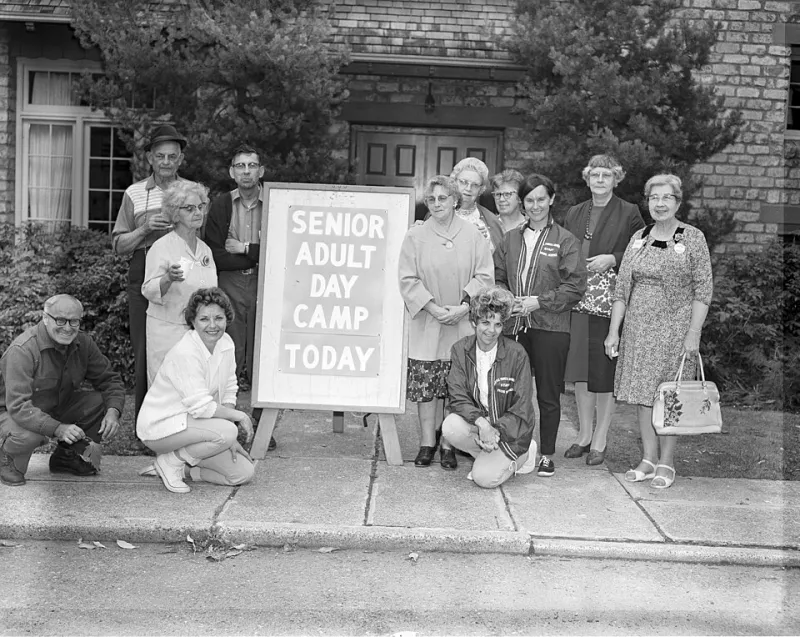
Photo: Seattle Municipal Archives from Seattle, WA, CC BY 2.0, via Wikimedia Commons
The first act of the night is a man in his forties attempting a card trick that fails in three separate ways. He fumbles the shuffle, drops the ace, and then — instead of slinking off — takes a bow. The room loses it. Not at him. With him. By the time the next person gets up and is somehow worse, the whole thing has turned into something else entirely.
That's the camp talent show. The talent was never the point.
The Act Is Not the Product
Nearly every summer camp in the country runs some version of this: skit night, campfire variety hour, the last-Friday show. The audience is captive, the lighting is a campfire, the sound system is whatever the maintenance guy had in his truck.
And yet people bring it up thirty years later. Ask anyone who went to camp and you'll hear about a counselor who fell off a stool, a cabin that sang an entire song in badly remembered Spanish, a kid whose "dance" was mostly walking with confidence. Almost nobody remembers who was good.
Which tells you something useful: the show isn't an audition. It's an agreement. For one hour, a room full of people agree that being bad at something publicly is a group activity instead of a private failure.
Why Shared Incompetence Bonds Faster Than Shared Excellence
Psychologists have poked at this from a few angles. The pratfall effect — the finding that a competent person becomes more likable after a small, human blunder — explains why the coolest counselor taking a pie to the face reads as warmth rather than weakness. But the camp version is bigger than one person's likability.
There's the self-disclosure research: people who reveal something unflattering tend to be liked more, not less, and the effect is strongest when the stakes are low. There's the improv principle behind "yes, and" — you can't do the scene right, so you stop trying to. And there's the simplest mechanism of all: laughing at yourself in front of other people is a way of saying I don't need you to think I'm impressive. That sentence is a skeleton key. It unlocks the room.
Curated competence does the opposite. When everyone at a gathering is performing expertise — the perfectly plated dish, the well-edited story, the job title dropped at the right moment — the group spends its energy ranking instead of relaxing. Nobody says so out loud. You can feel it.
Wabi-Sabi, Minus the Merch Table
Japanese aesthetics has a term for what happens when the trick fails and the room gets warmer: wabi-sabi, the appreciation of the imperfect, the incomplete, the impermanent. In the US it usually gets sold as a decorating style — cracked pottery, oatmeal linens, a very expensive bowl. That's a translation error. Wabi-sabi isn't about acquiring beautiful flaws. It's about loosening your grip on how things were supposed to go.
The tea ceremony is the clearest example. The host chooses the utensils, cleans the room, and then — this is the part people skip — deliberately leaves something imperfect. A slightly asymmetrical bowl. A flower arranged off-center. The imperfection isn't a failure to be corrected. It's an invitation for the guest to stop evaluating and start being present.
The camp talent show is a tea ceremony with worse acoustics. The asymmetry is built in. Everyone gets the same ninety seconds and the same unearned applause, and the audience quietly stops grading.
The Adult Camp Boom Is Really a Permission Boom
The grown-up summer camp phenomenon — retreat weekends, adults-only sleepaway programs, corporate offsites with a fire pit and a guy named Dave on acoustic guitar — keeps selling out. It isn't because thirty-eight-year-olds have a burning need to learn archery. It's because American adult life offers almost no sanctioned venue for being unimpressive in front of other people.
Work rewards polish. Dating rewards polish. Social media rewards a kind of polish that takes four hours. Then we wonder why everyone is exhausted and nobody feels close.
A retreat will charge you a thousand dollars and hand you a lanyard, and the thing you'll remember is the night the CFO did a magic trick that failed in three separate ways.
How to Run a No-Talent Night
You don't need a lodge in the woods. You need a room, a rule, and about ninety minutes.
The rules. Everyone performs. Every act runs under ninety seconds. Nothing is scored. The only permitted response is applause — no judging, no "wait, you're actually good!" (that's still a verdict, even a kind one), no filming. Phones go in a basket by the door, because a camera turns a room into an audience, and an audience turns a person into a performer.
Prompts, for when people freeze:
- Teach the room a skill you have at a strictly beginner level. Guitar, origami, a decent impression of your dad.
- Perform the worst version of something you're genuinely good at.
- Read aloud the most embarrassing sentence from something you wrote before age sixteen.
- Do a dramatic reading of a piece of junk mail.
- Group karaoke. Everyone sings. No solos.
The structure that makes it safe. Go first, and go badly. If you're hosting, your job is to be the least impressive person in the room for the first three minutes. Pair the shy people with someone they already like. End with a group disaster — everybody singing, nobody onstage — so the night closes on a room instead of a person.
The one thing to avoid. Don't let it become a competition with a wink. The second there's a winner, the permission evaporates.
What You Actually Take Home
You will not remember what anyone did. You'll remember that they did it. That's the entire return on investment, and it compounds: a group that has watched each other flop is measurably easier to be honest with later, because the worst-case scenario already happened and the room stayed warm.
You don't have to go back to camp to get that. You just have to be willing to be the guy with the cards.